

Four questions, five programmes
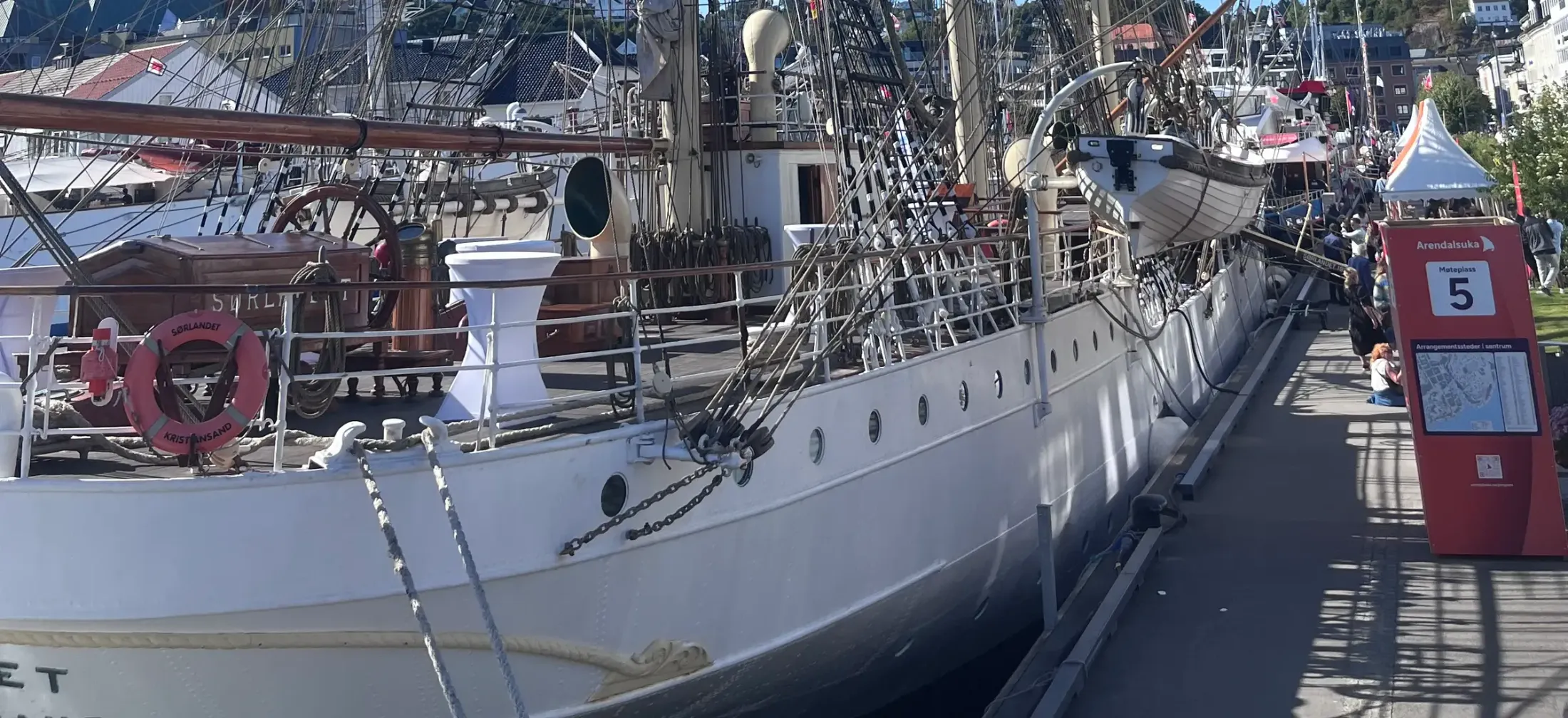
I sat in the audience at NVENorway's Directorate of Water Resources and Energy - regulates the electricity and water resources sectors.'s power contingency conference in Bergen, at the Norwegian District Heating Association's annual meeting, at Kongsberg Agenda and at Framtidsfredag in Steinkjer, and I was at Arendalsuka in August.
Five different programmes, five different audiences. A contingency conference and a democracy festival have little in common on paper. Even so, the same four questions came back everywhere:
- The queue. Who gets in when the grid cannot take everyone?
- Preparedness. What does national security have to do with power generation?
- Land use. How do we build more without the conflicts stopping us?
- Efficiency. How do we get more out of what is already standing?
They connect, and beneath all four lies the same requirement, which none of the programmes said out loud: knowing what is actually there, not what was registered last year.
One thing deserves a separate mention. The research community turned out in force in Arendal, and NTNU and SINTEF went the extra mile. Mid-week they launched the report Hvem skal få energien? (Who should get the energy?), together with SSB, FFI and NHH. It is written for precisely the situation the rest of the programme was talking around, and several of the figures below come from it.
The queue for grid capacity
Requests from industry, data centres, transport and new business are growing faster than grid and generation are being built. The hard discussion is therefore no longer whether to build, but who gets in first.
The report puts numbers on it. More than 14,592 MW sits in the connection queue at StatnettNorway's system operator for the transmission grid - owns and operates the high-voltage network and operates Elhub., and 8,398 MW of that is data centres. More than half the queue is a single sector. And although Norway has a power surplus in normal years, exporting somewhere between 12 and 34 TWh, the queue is now so long that grid expansion alone will not clear it. More generation is needed too.
The paradox is worth dwelling on: you can be turned down where you want to establish yourself while capacity sits idle somewhere else. The power system has to deliver capacity exactly where the consumption is, and the electricity has to physically get there.
The question of who should be let through was asked in every hall, without anyone answering it. That it is being asked at all is new.
The report brings order to it by setting out three dilemmas rather than one position:
- Market or strategic priority. The open power market allocates by willingness to pay. That is efficient, but willingness to pay does not capture everything of value. Encroachment on nature and national security carry no price tag in the bidding.
- Queue or societal benefit. First come, first served treats everyone equally, and that is the scheme's strength. But it can also lock a critical project behind one that merely arrived earlier.
- National plan or local democracy. Municipalities decide over their own land. The sum of many individual decisions still becomes a national power system nobody drew.
That they stand as dilemmas rather than recommendations is exactly the point. All three carry a real cost on both sides.
The report also has a chapter on how the neutral market is not necessarily neutral. Reduced electricity taxA Norwegian excise duty per kilowatt-hour consumed, collected by the grid company on the grid rent invoice and paid to the state., CO₂ compensation, concession power, price support and tax exemptions each distort the price signal.
That inverts the question many ask about power-intensive industry. The discussion is not whether to introduce special terms, but which ones already exist and who they in practice move to the front of the queue.
The package on the table
Three days before Arendalsuka opened, the government presented a package for faster build-out of power generation and grid. The ambition is to halve the time it takes. For comparison, major power lines have taken up to fourteen years from plan to finished facility.
The concrete measures landed exactly where the discussions stood:
- A two-year processing deadline for NVENorway's Directorate of Water Resources and Energy - regulates the electricity and water resources sectors. on grid applications.
- The state governor's right of objection to grid projects is removed. The Sámi Parliament's rights remain.
- Simplified environmental assessments, to weed out studies that add nothing.
- Municipalities receive production tax from construction start for wind power, rather than only when the facility is complete.
- The zoning plan requirement is removed, and municipal consentThe end user's expressed permission for someone else to see or process information about them. In the power market it is the consent that gives a third party access to metering data. is written into a separate act outside the Planning and Building Act.
Note that the package pulls in two directions at once. The state governor's objection disappears, which is centralisation. Municipal consentThe end user's expressed permission for someone else to see or process information about them. In the power market it is the consent that gives a third party access to metering data. is written into law, which is the opposite.
That is not inconsistent. It is the third dilemma, handled. The government removes a body that could stop a project on state grounds, and strengthens the body that can stop it on local grounds. Whether it gets faster depends on whether municipalities say yes more often once they are paid from day one.
The timing is worth noting. The package came on 7 August, the report from the research community on 10 August. One describes the dilemmas, the other is an attempt to resolve them, and they met in Arendal the same week without having spoken first.
Preparedness became an energy word
This was the summer's biggest theme, and it can be counted. Search the Arendalsuka programme and "beredskap", preparedness, returns 525 events. None of the other three questions came close.
My summer began at NVENorway's Directorate of Water Resources and Energy - regulates the electricity and water resources sectors.'s power contingency conference in Bergen, and what stood out was how little that discussion stayed there. The preparedness theme followed me on to events that were not about preparedness at all.
The link between energy policy and national security has sharpened considerably. Renewable generation is now presented as something that reduces vulnerability and dependence on unstable markets, not only as a climate measure. Stronger Nordic energy cooperation was discussed in the same breath as the new Nordic defence coordination.
This is also where the wind-versus-nuclear discussion actually belongs. Framed as a choice between two technologies, it becomes a trench. Framed as a question of diversity in the generation mix, it becomes something else: a system standing on many legs does not topple as easily as one standing on two.
But that discussion will not solve this decade. The Norwegian nuclear powerElectricity generated by nuclear fission of uranium or plutonium - emission-free during operation, stable baseload, and an increasingly prominent part of the European energy debate. committee has concluded that nuclear is currently too expensive in Norway, and that the first plants could be operating around 2045 at the earliest. That does not make the debate uninteresting, but it moves it out of the question of who gets into the queue now.
The shift is worth noting for anyone who supplies something to this industry. Security was long a question that surfaced towards the end of a procurement, often as an annex. It is now the premise for the entire conversation. And it is not only about generation itself: it reaches the supply chain, the operating agreements and the question of who is allowed to touch the systems at all.
That is also where the 525 events become something other than a trend. When an entire programme turns towards preparedness, the requirements change for everyone delivering into it, not only for those who own the plants.
And preparedness is more concrete than the word suggests. To handle something failing, you need to know three things: what you have, what condition it is in, and how quickly you can obtain a replacement. None of the three is answered by a contingency plan in a binder. They are answered by registers that are current on the day it matters.
What was barely mentioned
And this is where the figure from the previous section gets interesting. 525 events mention preparedness. NIS2EU directive on network and information security - imposes strict security requirements on critical infrastructure. is mentioned in four.
It is the directive that turns preparedness from ambition into obligation. Risk assessments, incident reporting within 24 and 72 hours, and a management responsibility that cannot be delegated down the organisation. Preparedness without NIS2EU directive on network and information security - imposes strict security requirements on critical infrastructure. is a value we agree on. With NIS2EU directive on network and information security - imposes strict security requirements on critical infrastructure. it becomes a deadline.
One requirement in particular deserves more attention than it got: supply chain security. NIS2EU directive on network and information security - imposes strict security requirements on critical infrastructure. makes your suppliers your responsibility. That is a bigger change for procurement than for IT operations, and it stood conspicuously quiet in the discussion about who should be let into the queue.
The exception this summer was Kongsberg Agenda, where I sat in on a good session that took NIS2EU directive on network and information security - imposes strict security requirements on critical infrastructure. and ISO 27001International standard for information security management systems - provides framework for protecting sensitive information. together. That is the connection missing from the wider debate: the directive says what has to be in place, while the standard is how most organisations actually get it there. Apart they are two conversations. Together they are a plan.
Perhaps the absence is because the directive feels like something coming rather than something here. But the supply chain requirements land on contracts being signed now and running for five years.
More power, less conflict
Build-out of new renewable generation is slower than hoped, and conflicts over land use are central. Wind, hydro and grid meet the same objections.
What has shifted is what the discussion is about. Less about yes or no to the individual project, more about how to choose sites with nature in mind from the start, how value is shared locally, and how licensing can move faster without biodiversity paying the bill.
What makes the third dilemma hard is that energy is a movable commodity. For a local community it can be decisive to use the power locally to create jobs. In aggregate, the same power may yield more somewhere else. Both are true at once.
Rooftop solar is the one part of this without a land-use conflict built in. The technical potential is estimated at between 12 and 38 TWh a year, and the constraint is pace and incentives, not space.
But the conflict does not disappear, it moves. Many small producers feeding into the same low-voltage network create voltage problems in the distribution grid, and those are not solved with more copper alone. They are solved by knowing what is happening in the grid, measured where it happens. Solar trades a land-use conflict for a data requirement, and that is a trade most would take.
Use what already exists
This was the clearest shift, and the one that drew the most attention. The report devotes a whole chapter to it, and the chapter title says everything: the energy we avoid having to build.
Before building out more nature, the search is now for the energy already there. Waste heat from data centres into district heating networks. Geothermal energy. Interplay between power, heat and grid, where district heating relieves the electricity grid precisely on the coldest days, when the grid is under the most pressure.
Note what happens to the data centre in that sentence. In the discussion about grid capacity it is the problem, the new consumer taking up more than half the queue. In the discussion about integrated energy systems it is the resource, the source of heat an entire neighbourhood can use. It is the same facility. The difference lies in whether it stands alone or is connected to something.
And here is a point the report raises that is easy to miss: the data centres have not been built yet. Established industry sits where it sits, but a facility not yet raised can be placed near a district heating network or another heat user. In Finland it is a common requirement that data centres be sited so they can contribute to district heating.
But the examples already exist here at home, and they are not pilots. At Ulven in Oslo, the Vaultica data centre delivers 5 MW of heat into Hafslund Celsio's district heating network, enough for around 5,000 flats at Hasle and Løren. Water leaves the servers at 15 to 16 degrees, and four heat pumps lift the district heating water from 50 to 80 before it reaches the homes.
The interesting part is not the engineering. It is that the plant has been profitable from day one, without subsidies. Waste heat is usually discussed as something that has to be subsidised into existence. Here it was built because the numbers worked.
Note the temperatures while you are there. The warmer the water is when it leaves the servers, the less work the heat pumps have to do to reach 80. That makes how the machines are run an energy question and not only an operations question: the choices inside the data hall decide how much the heat is worth to the neighbour outside it.
At Rjukan it looks different. There, Green Mountain supplies surplus heat to Hima Seafood, which runs the world's largest land-based trout farm. The water drawn from the reservoirs beneath the site is too cold for the fish, and the heat from the data centre makes it usable. Green Mountain charges nothing for it.
Note that the recipient there is not a district heating network. The heat went where someone needed it, and that is a wider opening than the debate suggests: waste heat is about what lies nearby, not about there having to be a city.
That makes siting a question of sequence, not of technology. The decision is made when the site is chosen, and it cannot be taken again afterwards.
And then there is a third role, which leads back to preparedness. A data centre is a load that can be turned down. Not all work has to happen right now, and a facility that can lower its consumption when the grid is strained is something other than a pure consumer. It is reserve.
That turns the question of who gets through the queue into a different question. Perhaps not only who arrived first, or who creates the most jobs, but who can move when it matters.
And beneath it all: the data
This is where it gets technical, and it is worth staying a little longer. Because all four discussions assume something none of them said out loud.
A politician can decree a two-year processing deadline. The deadline makes no difference if nobody knows what is actually in the queue when the clock starts. A decision without current data is a decision made blind, and then we have only moved the bottleneck from casework to knowledge.
To prioritise the queue, you have to know what is actually in it, not what was registered last year. To connect a data centre to a district heating network, two companies have to share operational data in real time, not in a monthly report. To choose sites with nature in mind, the maps have to talk to each other. And for preparedness to be real, someone has to be able to see the whole picture before it becomes urgent.
Interest in AI was high at every event. But a language model laid over data sitting in silos does not produce better decisions. It produces faster guesswork, expressed with greater confidence.
And the silos are only half of it. Data gathered in one place but wrong produces exactly the same outcome. A metering pointThe fundamental unit in Elhub - the unique point in the electricity network where energy is measured and settled, identified by an 18-digit GSRN number. registered at the wrong address, a componentA replaceable part inside a fixed asset. It has its own age, its own history and its own service life - independent of the asset it sits in. replaced last year without anyone recording it, a capacity stated in a unit nobody wrote down: the model sees no difference between that and a correct figure. It answers just as convincingly either way.
Data quality is therefore not a tidying exercise you finish before adopting AI. It is the precondition for the answer meaning anything, and that work does not shrink because the tools get better.
The same holds for reporting. ESGEnvironmental, Social and Governance - framework for measuring and reporting sustainability in business. figures are drawn from the same registers as everything else, and a company that does not know what it has does not know precisely what it consumes or recovers either. The requirements for what must be reported keep tightening, while the basis is the same as it always was. Whoever keeps the registers in order does not just report more easily, but more accurately.
What actually moves something is duller: open interfaces and documented APIs, so one system can ask another without someone exporting a file first.
And now MCPOpen protocol from Anthropic enabling AI agents to communicate with external tools and data sources in a standardised way., which is a standard for the same thing, aimed at language models. It lets a model fetch the answer from the source rather than be fed an extract someone cut out in advance. The difference is the same as between looking it up in the register and asking someone who remembers what it said last year.
Without that layer, the four big questions remain opinions against opinions.
That is where we at TvimenningOld Norse meaning 'two bound together' - one who solves a task shoulder to shoulder with another. work, and it is the three preparedness questions again. RUNATvimenning's component register for electrical installations - providing structure and traceability for the components installations are built from. is the register of what is actually out there. FRAMSYNTvimenning’s tool for condition-based maintenance: raises work orders from how the component is actually doing, not from how old it is. says what condition it is in, based on real data rather than age. LEIDANGTvimenning’s closed, non-commercial marketplace where energy companies share preparedness resources between themselves - components such as transformers, cables and smart meters, and contact points for response crews. is the market for obtaining a replacement from another grid company instead of waiting for a new one. ISO 27001International standard for information security management systems - provides framework for protecting sensitive information. is the certification that the systems holding the answers are actually managed.
None of this was chosen because preparedness made the programme this summer. But it answers the same thing, and that may be the most interesting part of a summer like this one: how much of what is now debated as policy is in practice a question of who has an overview.
Source
The figures and the three dilemmas come from Hvem skal få energien?, published August 2026 by research groups at NTNU, SINTEF, SSB, FFI and NHH. Editors are Asgeir Tomasgard (NTNU), Ellen Krohn Aasgård and Karoline Ski (both SINTEF). ISBN 978-82-14-08725-3. The report was launched at Arendalsuka on 10 August and is available from sintef.no.
The measures for faster build-out come from the government's press release Regjeringen tar store grep for raskere utbygging av kraft og strømnett, Office of the Prime Minister and Ministry of Energy, 7 August 2026.
The Rjukan example comes from NRK's report Overskuddsvarme fra datasenter: en løsning for bærekraftig oppdrett, 7 February 2026. The Oslo figures come from Klima Oslo, Oslo-datasenter varmer opp 5000 leiligheter.
The five events, with programme and organiser, are listed under past events.
Everything else in this text is my own impression from the audience, and stands on my account.