

What is SEFTA?
SEFTATvimenning’s VEE engine: validates, estimates and edits metering series with versioned time series and a full audit trail, before data goes to Elhub. handles validationThe first step in VEE - automated checks of metering data against technical and logical limits to detect obviously erroneous values., estimationThe second step in VEE - calculation of missing or rejected metering values based on historical patterns, neighbouring meters or statistical models., and editingThe third step in VEE - manual correction of metering values that cannot be resolved automatically, with full audit trail for all changes. of metering data with full versioning, traceability, and export-ready output. SEFTA turns raw readings into compliant measurements that withstand regulatory scrutiny.
What it looks like
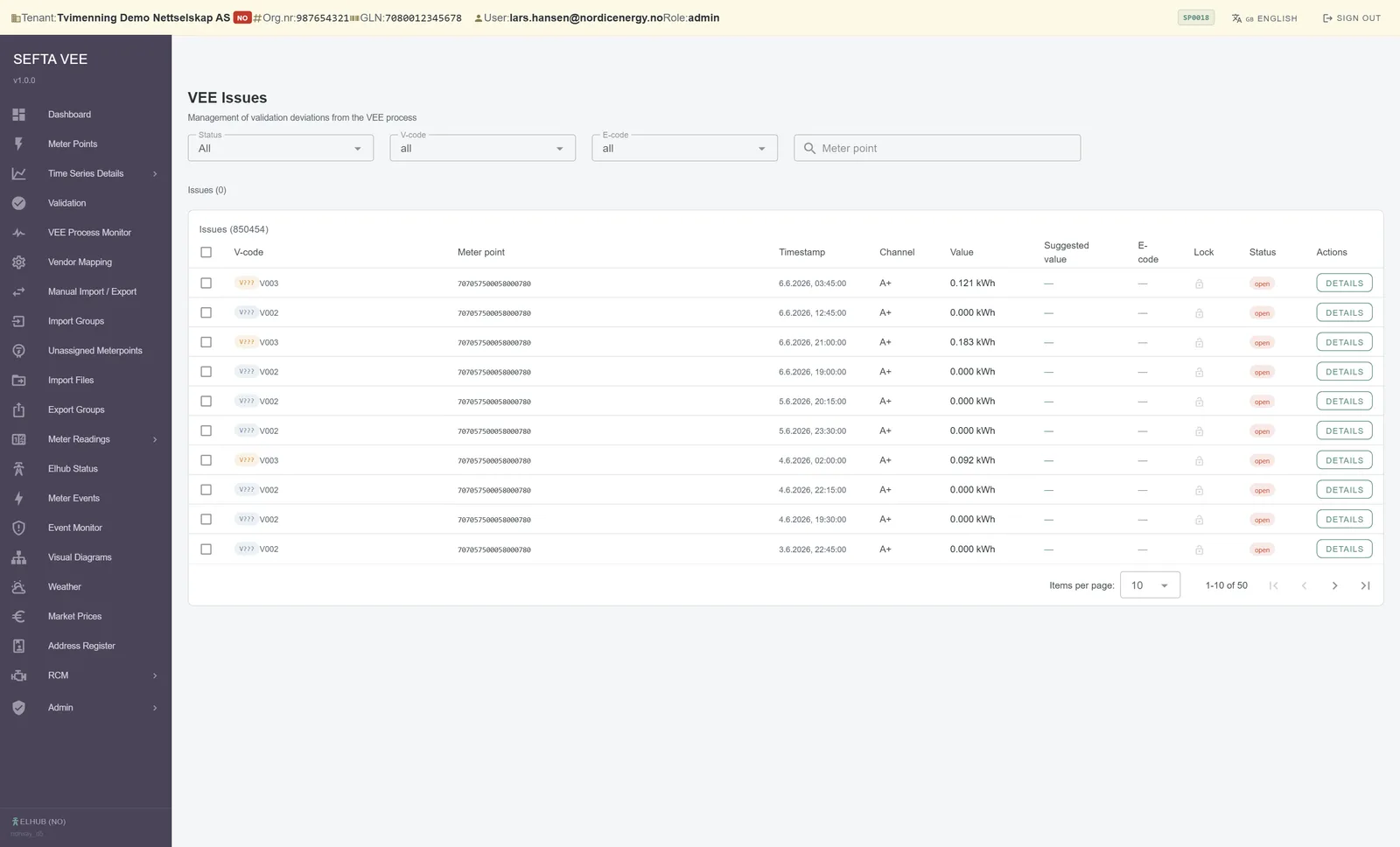
SEFTA in use
Process flow
AMS/AMI → Validation (error check) → Estimation (fill gaps) → Editing (manual) → Approved to Elhub
Key features
Eight validation rules
The first step of VEEValidation, Estimation, Editing - systematic process to ensure quality of raw metering data from electricity meters.. Eight rules run automatically on incoming meter data, catching everything from physically impossible values to clock drift and stuck meters. Thresholds and business rules are configurable.
Estimation in six steps
The second step of VEE. Estimation fills the gaps: where a value is missing or rejected, a six-step cascade calculates it from historical patterns. The cascade is traceable, so an estimated value can be told apart from a measured one.
Mass outage and the five-day window
When many meters drop out at once, the values are estimated automatically and marked as estimated. Five days then run for the real values to arrive from the meter. If the collection system reports a power outage rather than merely a missing value, SEFTA sets the value to final estimated straight away, and the window falls away.
Editing, the third step
What validation and estimation cannot resolve is corrected by hand. The editing happens inside the same workflow, not in a spreadsheet beside it, and the change enters the trail along with everything else done to the series.
Versioned time series
Meter data is stored as versioned time seriesMeasurements of the same quantity repeated over time. The order and the timestamp are part of the data, not decoration., not as a table that gets overwritten. Every validation, estimation and edit enters an audit trail showing who changed what, when and why, and the value as it stood before the change remains.
Exceptions, not review
Series that pass every rule move on without anyone looking at them. What stops is left as an exception to be dealt with, so the time goes to the values that actually need judgement.
Export-ready out of the engine
The result is fully validated and estimated series, ready to be sent on to ElhubNational hub for metering data and market processes in the Norwegian electricity market.. SEFTA does not do the message exchange itself - that belongs in the SAMTYGDA shared integration layer to the modules, the surrounding systems and market hubs such as Elhub. integration layer, and SEFTA supplies the data that goes there.
Consumption, generation and heat
The same engine whatever is measured: consumption data from end-user meters, generation data from hydro, wind and solar, and data from heat meters in a district heating network. What differs between customer types is the values and the rules, not the workflow.
Built for the MDR role
Responsibility for metering valueOne measurement from one metering point for one period of time. The building block all settlement rests on. quality sits with whoever establishes and validates them - the metering value owner (MDRThe Elhub market role a grid company holds for establishing and validating meter values. Tvimenning is approved in this role.). Grid companies, power producers and district heating producers run VEE and deliver onwards; those who only receive approved values do not.
Metering Regulations § 3-6
The VEE requirement is not industry custom. It sits in § 3-6 of the Norwegian metering regulations, "Standard for validation, estimation and editing of metering values for interval-settled metering points", and that is the provision SEFTA is built against.
Results you can expect
- ✓Less manual intervention
- ✓An audit trail on every value
- ✓Faster exception handling
- ✓Automated compliance checks
Get started quickly
SEFTA is built for rapid implementation. Typical setup takes weeks, not months.
- Dedicated implementation support
- Integration with existing systems
- Training for your team
- Ongoing support after go-live
Who uses SEFTA?
Grid companies
Automate the VEE workflow and ensure all meter readings are validated and export-ready for Elhub.
Power producers
Validate and estimate generation data before it goes to Elhub - instead of discovering the gaps when somebody else complains.
Metering companies
Deliver validated meter readings as a service to multiple clients with full traceability.


Ready to see SEFTA in action?
Book a demo and we will show you how SEFTA can solve your specific challenges.