
What is GJELDE?
When someone asks why the invoice came out the way it did, the answer is rarely in one place. The metering values come from one place, the tariffs from another, the contract terms from a third, and the calculation rules often live with whoever did the job last time. GJELDE is the place where these meet, and where the result can be shown: what each party is owed, and what basis the number rests on. The tariffThe component of electricity customers' bills that covers grid rental - regulated by NVE. is usually the hardest part, because it is not one price but a structure of a fixed charge, an energy charge and a capacity charge, and it can change in the middle of a period. If the metering valueOne measurement from one metering point for one period of time. The building block all settlement rests on., the tariff, the agreement and the rule sit together and traceably, the answer is short. If they sit scattered across spreadsheets and systems, it becomes an investigation. Nor does GJELDE stop at the number. The invoice is produced and sent, gentle reminders are handled inside the system, and debt collection runs through an integration - the basis travels the whole way, including when the case ends up with someone else. GJELDE does not require the customer to replace anything: metering data can come from SEFTAValidation, estimation, and editing with versioned time series, traceability, and export-ready data. and metering pointThe fundamental unit in Elhub - the unique point in the electricity network where energy is measured and settled, identified by an 18-digit GSRN number. and installation data from SPIRAOne consolidated register for metering points, installations and assets - the source of truth the rest of the chain builds on. where they exist, and otherwise it takes an integration with the customer’s own systems.
What it looks like
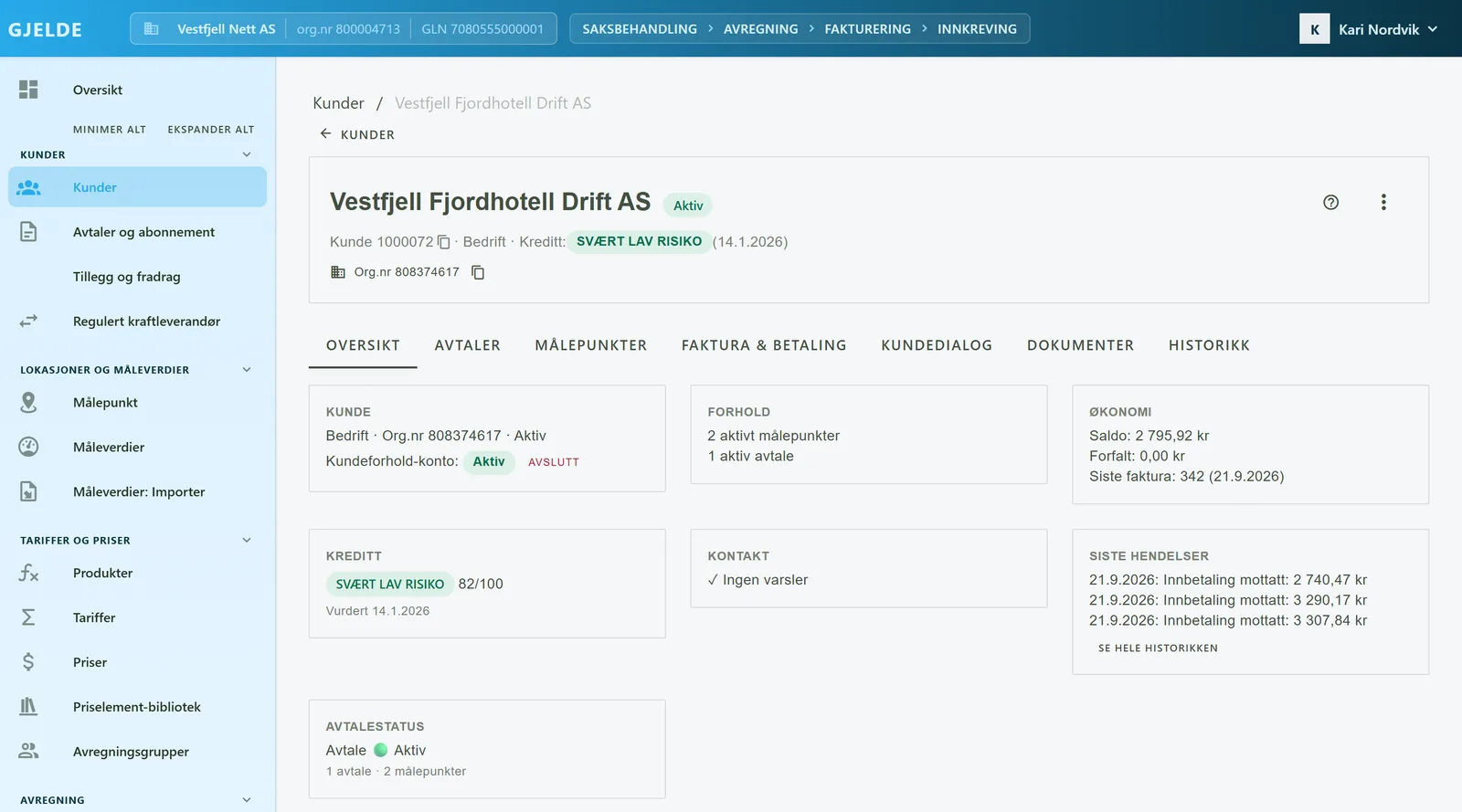
GJELDE in use
Process flow
Metering values from SEFTA, or via Elhub → Settlement (tariff, contract, rule) → Invoicing → Reminders in the system → Collection via integration
Key features
The basis travels with the number
Every line in a settlementTurning metering data into money. Consumption and production per metering point become what each party owes or is owed. can be traced back to the metering value, the tariff, the agreement and the rule behind it. An amount without that chain is a claim, not a settlement.
The tariff that applied then, not the one that applies now
Tariffs and agreements change, and a tariff change mid-period must not bleed backwards. A settlement is calculated on what was in force at the time, even when it is redone six months later.
Disputes are settled with evidence, not trust
When two parties disagree about an amount, the question is always what the calculation rests on. If the basis is open to both, the discussion is short.
Norwegian schemes, not generic pricing
NorgesprisA Norwegian state scheme letting households choose a fixed electricity price instead of the variable market price., the electricity subsidyNorwegian state scheme covering part of a household’s electricity cost when the market price exceeds a threshold., the electricity dutyA Norwegian excise duty per kilowatt-hour consumed, collected by the grid company on the grid rent invoice and paid to the state. and the Norwegian grid tariffPayment for using the electricity grid - covers transport from producer to consumer and is regulated by NVE. models are not variants of a generic price list. Each has its own rules for who is covered, which hours count and how the amount is calculated. Handled as exceptions bolted onto a generic engine, they become a maintenance problem every time a rule changes.
Elhub is part of the calculation
For grid and power, metering values travel via ElhubNational hub for metering data and market processes in the Norwegian electricity market. before they become an invoice basis, and supplier switches and annual consumption arrive the same way. A switch mid-period moves who is owed for what, and that has to land correctly in the settlement. District heating sits outside Elhub, and there the metering values go straight from SEFTATvimenning’s VEE engine: validates, estimates and edits metering series with versioned time series and a full audit trail, before data goes to Elhub. into invoicing.
Builds on what is already there
Metering data from SEFTA and metering point and installation data from SPIRATvimenning's metering point and asset register - your single source of truth for master data, with a built-in validation engine and Elhub integration. where they exist. If the basis lives in the customer's own systems instead, it takes an integration - neither module is a requirement.
Results you can expect
- ✓One settlement instead of several spreadsheets
- ✓A shorter path from question to answer on an invoice
- ✓An auditable basis when someone asks
- ✓Fewer settlements that have to be redone
- ✓The same answer whoever does the calculation
Get started quickly
GJELDE is built for rapid implementation. Typical setup takes weeks, not months.
- Dedicated implementation support
- Integration with existing systems
- Training for your team
- Ongoing support after go-live
Who uses GJELDE?
Grid companies
Grid rent is assembled from a fixed charge, an energy charge and a capacity charge, with electricity duty on top and Norwegian schemes affecting what the customer actually pays. All four can change on different dates. Metering values travel via Elhub before they become an invoice basis, and the metering points come from SPIRA the moment they are created.
District heating companies
Heat is metered and priced under its own models, and these companies sit outside Elhub. Metering values therefore go straight from SEFTA into invoicing, without the detour through the market. The mechanics of a settlement are the same - metering value, price, agreement, rule - but the rulebook is a different one, and system support is often thinner than in the grid sector.
Electricity suppliers
The power price follows the market hour by hour, while Norgespris and the electricity subsidy shield the customer in different ways. Which scheme a customer is in is a choice that can change mid-period. Supplier switches and annual consumption come from Elhub, and have to land in the right period in the settlement.



Ready to see GJELDE in action?
Book a demo and we will show you how GJELDE can solve your specific challenges.