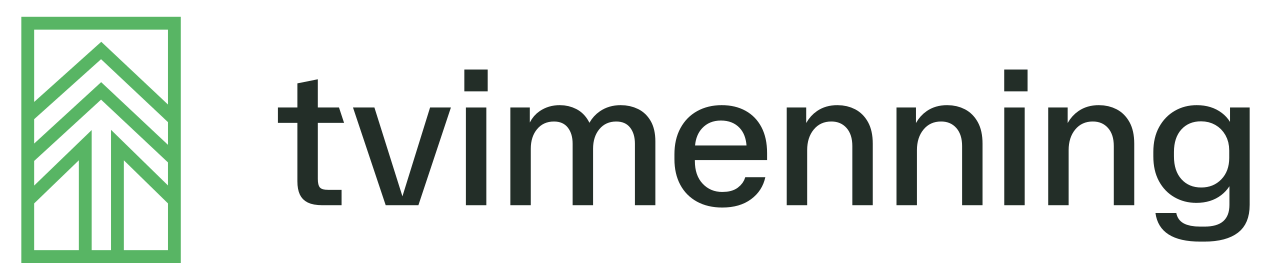
The rune ᛏ - seventeenth in the Elder Futhark and the one that names Týr's aett. Called after Týr, the Norse god of law, assembly and the sworn oath. Tvimenning's logo is built from this rune.
Definition
Tiwaz is Tîwaz or Teiwaz in Proto-Germanic, Tír in Old English and Týr in Old Norse. It stands seventeenth in the Elder Futhark and twelfth in the Younger, carries the sound value t, and is written ᛏ. The shape is an upright stave with two strokes meeting in a point at the top - one chevron.
Týr is the god of law, of the thing-assembly and of the oath. The rune poems call him one-handed: the Old Norwegian «Tyr er einhendr áss», the Icelandic kenning «úlfs leifar» - what the wolf left behind. The Old English stanza says the rune «keeps faith well with princes».
The reason is the Fenrir myth. The gods meant to bind the wolf with the fetter Gleipnir, and Fenrir demanded a pledge because he suspected a trick. Only Týr laid his hand in the wolf's jaws, and he knew the fetter would hold. It held, and he lost the hand. The god of oaths gave his one false pledge, and paid for it with something he did not get back.
Stacked Tiwaz is an attested form, not a modern invention. The rune was cut several times over itself on the same stave, and the three known finds are the Lindholm amulet from the 2nd to 4th century with three consecutive t-runesThe Norse alphabet - the oldest Germanic script, used by Norse peoples from around 200 AD through the Viking age and into the Middle Ages., the Kylver Stone from Gotland around 400 AD with eight stacked Tiwazrunes, and a Danish C-bracteate (Seeland-II-C) from around 500 AD with three stacked. The stacking is read as an invocation or an intensification of Týr.
Our mark has three visible chevrons, and it can be read two ways that are both true to the source. Either as two Tiwaz runes offset by exactly one chevron, one in front and one behind - the fourth is hidden behind the foremost, and two of a kind close enough to overlap is precisely a tvimenning. Or as one threefold stacked Tiwaz, the form the bracteate and the amulet actually carry.
The ambiguity is not a vagueness we need to resolve. It is the same figure seen from two sides, and both readings say something true about how we work: two alike enough to trust and different enough to be useful, and a mark cut one time too many on purpose.
In practice
Our mark has three visible chevrons, and it can be read two ways that are both true to the source. Either as two TiwazrunesThe Norse alphabet - the oldest Germanic script, used by Norse peoples from around 200 AD through the Viking age and into the Middle Ages. offset by exactly one chevron, one in front and one behind - the fourth is hidden behind the foremost, and two of a kind close enough to overlap is precisely a tvimenningOld Norse meaning 'two bound together' - one who solves a task shoulder to shoulder with another.. Or as one threefold stacked Tiwaz, the form the bracteate and the amulet actually carry.
The ambiguity is not a vagueness we need to resolve. It is the same figure seen from two sides, and both readings say something true about how we work: two alike enough to trustTrust - one of Tvimenning's core values and foundation for long-term customer relationships in the energy sector. and different enough to be useful, and a mark cut one time too many on purpose.