
RUNA
Structure and control over the components that installations are built from
What is RUNA?
RUNATvimenning's component register for electrical installations - providing structure and traceability for the components installations are built from. covers the full lifecycle of physical assetsPhysical equipment owned and used over time - transformer, cable, breaker. It has both a technical and an accounting side, and the two rarely agree. in one system: design, construction, commissioning and ongoing maintenance. Construction projects follow a phased lifecycle with FATFactory Acceptance Test - testing of equipment at the supplier before it ships to site. and SATSite Acceptance Test - testing of the equipment where it actually stands, after installation. checklists built on the RENNorwegian Organisation for Rational Electric Network Operations - industry organisation for technical standards in electricity networks. standards, and with external reporting to NVENorway's Directorate of Water Resources and Energy - regulates the electricity and water resources sectors. and StatnettNorway's system operator for the transmission grid - owns and operates the high-voltage network and operates Elhub.. The register stores every installation interval with a timestamp, so it can answer where a componentA replaceable part inside a fixed asset. It has its own age, its own history and its own service life - independent of the asset it sits in. is now, where it was before, and when each assignment began and ended. A digital twinVirtual copy of a physical object or system that updates in real time - used for simulation and optimisation in the power grid. of the grid is no truer than the component data beneath it. The simulation knows the transformer it was told is there, not the one actually standing there, with its vintage and its history. If the underlying record lives in spreadsheets, the model inherits the spreadsheet. RUNA does not solve the simulation, but the layer below it: which component, where, and since when. That is the difference between modelling the grid and modelling an assumed grid.
What it looks like
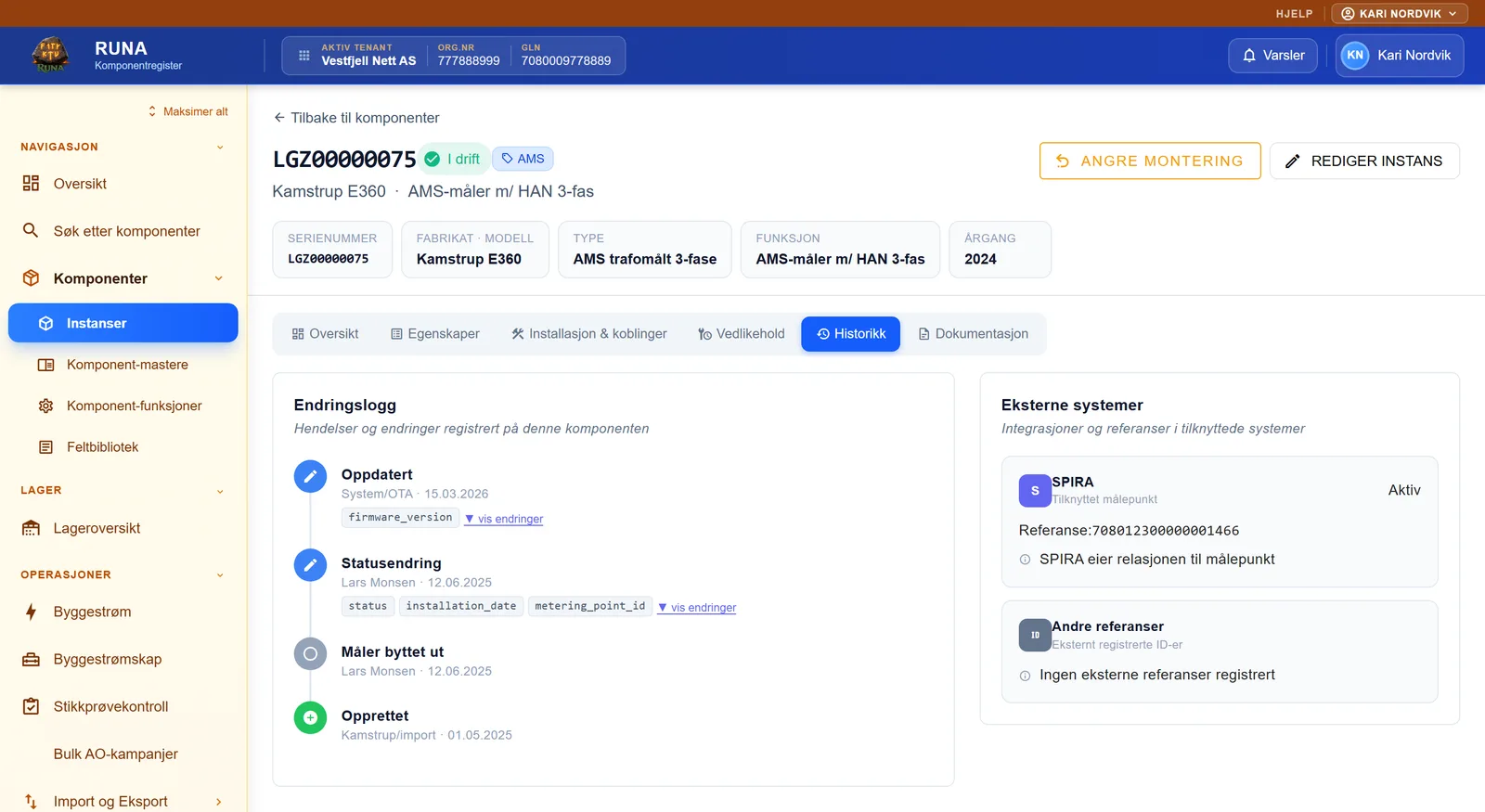
RUNA in use
Key features
From design to maintenance in one system
Construction projects follow a phased lifecycle from design through construction and commissioning to maintenance, with FAT and SAT checklists built on the REN standards and external reporting to NVE and Statnett. The handover from project to operations is not an export, but the same data set changing phase.
Component catalogue
The catalogue describes the component types a grid is built from: the meter with its type, vintage and properties, the transformer with its application and history, and the modem, concentrator and repeater. Specifications live on the type, not on each unit, so a new installation inherits the description.
Normalised structure
A standardised data model ensuring consistency across installations and projects, so a transformer means the same thing in two projects built five years apart, and reports can be assembled without manual translation.
SPIRA integration
Tight integration with SPIRAOne consolidated register for metering points, installations and assets - the source of truth the rest of the chain builds on. to link components to metering points and installations. RUNA answers what a component is; SPIRATvimenning's metering point and asset register - your single source of truth for master data, with a built-in validation engine and Elhub integration. answers where it sits and who is connected to it. Every installation interval is stored with a timestamp, so the question "which meter was here last year?" has an answer rather than an estimate.
Reusability
Define a component once and reuse it across installations, instead of retyping the same specification for every project. The GlobalIDA unique id that follows a component for its entire lifetime, across every system it appears in. The technical term for it is UUID. follows the individual unit through its whole lifetime and across the systems it appears in, so its history stays intact even when the component is moved.
Document management on NOARK principles
A single document library across locations, assets and projects, with templates, keywords and versioning. Disposal leaves a tombstone, so an audit can see that a document existed and when it was disposed of. The solution follows the NOARK principles; it has not been tested against a Noark 5The Norwegian standard for records management in the public sector - requirements for journaling, versioning and disposal. core.
Audit log and event log
A read-only audit log with archiving, and an event logStoring everything that has happened as an immutable sequence of events, and deriving current state by replaying them, instead of overwriting. showing who has been logged in and when. Section 7-4 of the Norwegian power-preparedness regulation requires control of user access; the log is designed to answer that question without manual reconstruction.
Timeline of events
Design, commissioning and maintenance work appear as coloured markers on a timeline. Dates can be narrowed and the timeline zoomed, and clicking a marker gives the details. It is the one view that shows a component’s full history without anyone having to search.
Check-out, so two people do not edit the same document
A document can be reserved on check-out. Only the person who reserved it, and an administrator, can release it. Everyone else sees who holds it and when it was locked, so they know who to talk to instead of guessing.
Maintenance even without a maintenance system
RUNA integrates with the maintenance system you have. If you do not have one, maintenance exists in a simpler form inside RUNA itself, so the register is not left waiting for something else to be procured first.
RDS designation and GlobalID
Each component gets a functional designation per RDSReference designation system per ISO/IEC 81346. Gives every component in a facility one unambiguous designation that holds for its whole life. (ISO/IEC 81346The standard giving every part of a plant an unambiguous designation by function, location and product. The basis RDS builds on.) and a GlobalID, a UUIDA unique id of 128 bits, written as 32 characters in five groups. What makes it useful is not the length but the fact that anyone can create one without asking permission. that follows the component for its whole lifetime and across the systems it appears in. The designation is what lets two systems talk about the same component without first agreeing on a name.
Grid infrastructure and assets
Not only the components sitting on an end-customer metering pointThe fundamental unit in Elhub - the unique point in the electricity network where energy is measured and settled, identified by an 18-digit GSRN number.: substations, transformer stations and power stations are registered as assets with the larger REN sheetThe specific technical standard documents from REN - one for each equipment or work area. structures they are actually built to. That is the part of the grid that otherwise ends up in spreadsheets because it does not fit a metering-point register.
Results you can expect
- ✓Project and operations on the same data set - no handover
- ✓Documented user access without manual reconstruction
- ✓Reduced time spent on component registration
- ✓Consistent data quality across projects
- ✓Easy reuse of standard components
- ✓Tight integration with SPIRA
Get started quickly
RUNA is built for rapid implementation. Typical setup takes weeks, not months.
- Dedicated implementation support
- Integration with existing systems
- Training for your team
- Ongoing support after go-live
Who uses RUNA?
Installers
Standardise component registration and eliminate manual errors by reusing approved components.
Grid companies
Get visibility into which components are used in the grid and ensure technical consistency.
Project managers
Plan installations faster with access to a standardised component catalogue.


Ready to see RUNA in action?
Book a demo and we will show you how RUNA can solve your specific challenges.